
 English
Odisha Boosts Panchayati Raj, Village Development

Odisha Govt Launches ‘Developed Village, Developed Odisha’ Initiative to Strengthen Panchayati Raj System: CM Majhi
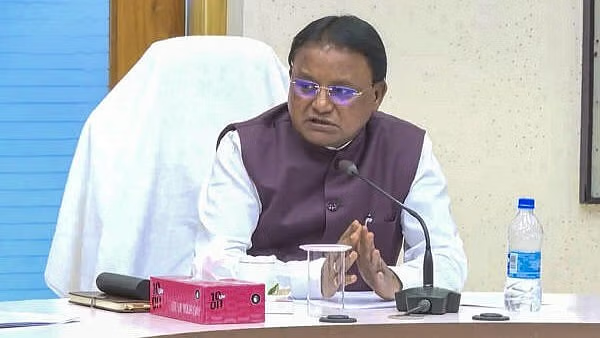
In a significant move to empower rural governance, Odisha Chief Minister Mohan Charan Majhi announced a series of initiatives aimed at strengthening the Panchayati Raj system during the National Panchayati Raj Day celebrations held in Puri.
Addressing the gathering, CM Majhi reaffirmed his government’s commitment to boosting rural infrastructure, emphasizing the importance of electricity, roads, and drinking water as fundamental needs. “Infrastructure is our top priority in rural areas. We are taking all necessary steps to build robust village infrastructure,” he said.
In a major announcement, the Chief Minister launched the ‘Developed Village, Developed Odisha’ initiative, setting an ambitious target to ensure drinking water access in all villages by 2026. He added that the government is also actively working to rejuvenate village-level democratic institutions.
Majhi began his address by paying tribute to the tourists who lost their lives in the recent terrorist attack in Pahalgam, expressing solidarity with the victims’ families.
Highlighting the achievements of the Panchayati Raj system in Odisha, CM Majhi noted that several Gram Panchayats in the state have gained national recognition in recent years, bringing pride to Odisha. He described the Panchayati Raj system as a “real laboratory” for inclusive development, particularly for women, pointing out that 50 percent of Panchayat seats are reserved for women. He praised women Panchayat representatives for their dedication and contributions to grassroots development.
Reflecting on his own journey, Majhi shared that he began his public service as a Panchayat representative in 1997, underlining his deep connection with rural governance. “For the past two and a half decades, the Gram Sabha and Palli Sabha had become inactive. But now, our government has revived the system to ensure villagers themselves decide the development course of their areas,” he said.
Among the key welfare measures announced was the Antyodaya Griha Yojana, under which the state government plans to provide housing to 5 lakh poor families in three years, with a budget allocation of ₹7,550 crore. He further stated that over 23 lakh houses have already been built in Odisha under the Pradhan Mantri Awas Yojana, with 4 lakh more currently under construction.
On the occasion, CM Majhi also launched a range of digital governance tools, including the e-Panchayat Sabha portal, the Panchayat Planning and Monitoring System (PPMS), and the Panchayat Monitoring System—developed by the National Informatics Centre (NIC). These platforms aim to enhance transparency, monitoring, and participatory planning at the grassroots level.
In a major welfare move, the Chief Minister announced the distribution of new ration cards to 6 lakh beneficiaries and the release of ₹32 crore as incentive funds to 613 village panchayats. Additionally, over 2 lakh Subhadra beneficiaries received two installments of ₹10,000 each.
To encourage sports and youth development in rural areas, the state government also laid the foundation stone for 314 block-level stadiums, with an investment of ₹4,124 crore.
The announcements mark a significant push by the Odisha government to empower rural communities, enhance local infrastructure, and foster inclusive development through a strengthened Panchayati Raj system.

