

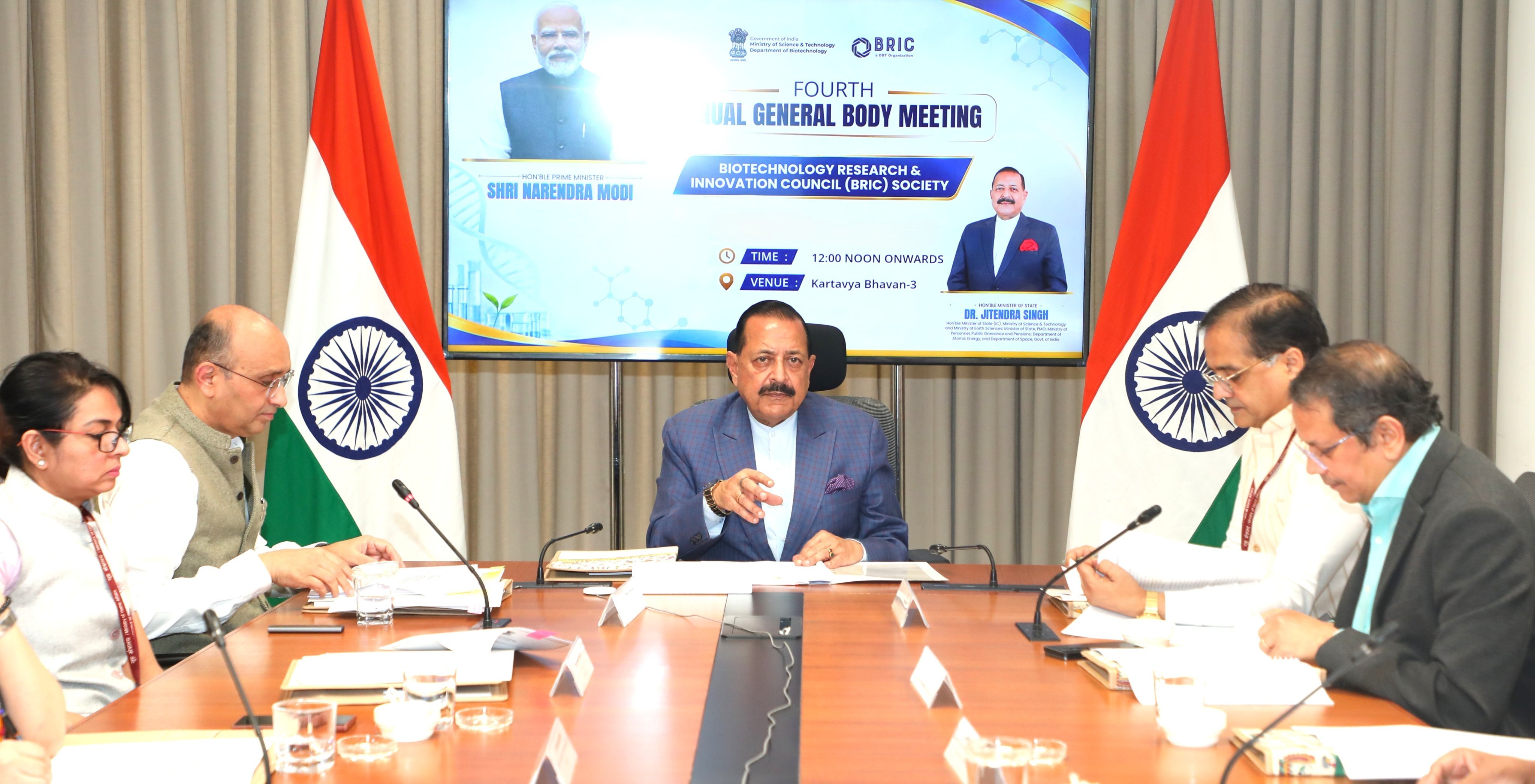
Union Minister of State for Science and Technology Dr Jitendra Singh on Saturday said the Biotechnology Research and Innovation Council (BRIC) aims to help India achieve a $300 billion bioeconomy by 2030 and expand it to $1 trillion by 2047.
Addressing the Fourth Annual General Meeting (AGM) of the BRIC Society at Kartavya Bhawan in New Delhi, Singh highlighted India's remarkable progress in biotechnology and emphasised the need to accelerate scientific innovation, research translation and industry collaboration.
The Minister said India's bioeconomy had grown from around $10 billion to more than $195 billion, reflecting the expanding contribution of science, technology and innovation to national development.
Describing BRIC as a pioneering initiative in institutional collaboration, Singh said the integration of biotechnology research institutions under a common platform had introduced a new model of scientific institution-building in the government. The approach enables institutions to share resources, infrastructure and research capabilities while retaining their individual scientific strengths.
The AGM reviewed BRIC's institutional progress, research achievements, governance reforms, scientific collaborations and future priorities. Dr Rajesh S Gokhale, Secretary of the Department of Biotechnology and Director General of BRIC, presented a detailed overview of the council's activities and achievements.
Singh welcomed BRIC's strong research performance, noting that it ranked first among government institutions in health sciences and second in biological sciences in India for the second consecutive year, according to the Nature Index India.
Emphasising the importance of converting scientific discoveries into practical solutions, the Minister said research should not remain limited to publications and patents but must translate into technologies, products and innovations that improve people's lives.
He highlighted research initiatives in healthcare, agriculture, animal health, advanced materials and technology platforms, including novel therapeutics, diagnostics, disease detection, climate-resilient agriculture and sustainable biomaterials.
The Minister also called for stronger partnerships between scientists, entrepreneurs, investors and industries from the early stages of technology development. He stressed that research commercialisation requires adequate funding, mentorship, industry partnerships and a better understanding of market and regulatory requirements.
Welcoming initiatives such as the Entrepreneur-in-Residence programme, Singh encouraged BRIC institutions to strengthen their engagement with startups and industry to accelerate biomanufacturing, technology development and commercialisation.
He further highlighted India's growing biotechnology startup ecosystem, which now comprises more than 11,000 startups, and urged young researchers to move beyond academic publications towards product development, technology translation and entrepreneurship.
During the meeting, members also discussed opportunities in artificial intelligence and biology, interdisciplinary research and ways to attract Indian scientific talent working abroad. Suggestions included leveraging the Vaibhav Connect platform to connect the scientific diaspora with research opportunities in BRIC institutions.
Referring to the D.E.S.I.G.N. for BioE3 Challenge, Singh said more than 6,000 proposals had been received from school students and citizens across the country, reflecting growing interest among young people in biotechnology innovation.
The meeting also witnessed the launch of the BRIC Handbook of Memorandum of Association, Rules, Regulations and Bye-laws, providing a consolidated reference for the council's governance and functioning.
Concluding his address, Singh said achieving India's ambitious bioeconomy targets would require greater investment in scientific innovation, research commercialisation, industry participation and talent development. He urged BRIC to emerge as a globally recognised platform for collaborative research and breakthrough innovation, ensuring biotechnology benefits farmers, patients, industries and communities.