English


Iran War Halts Global Economic Momentum

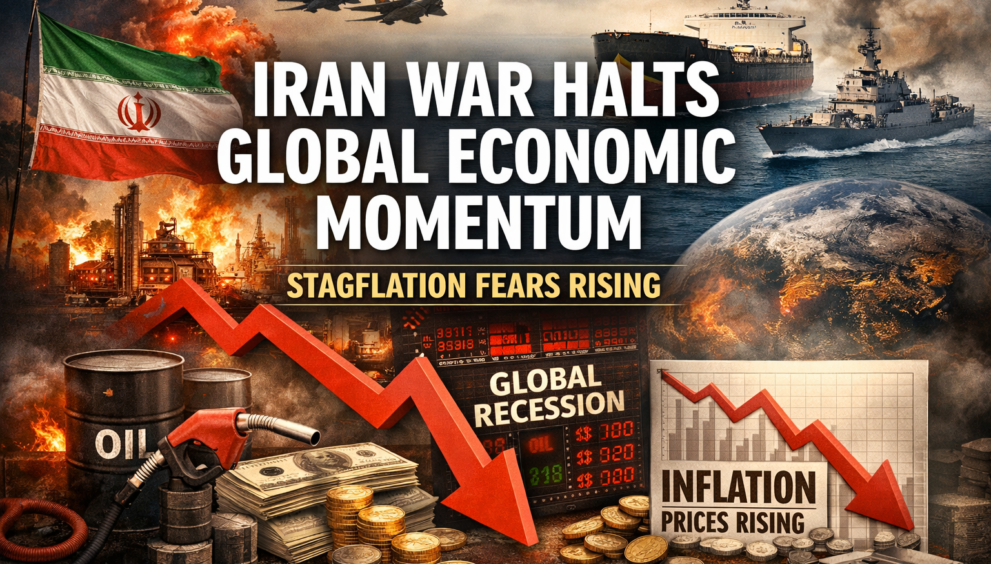
Iran War Jolts Global Economy, Raises Stagflation Fears
The ongoing conflict involving Iran is sending shockwaves through the global economy, threatening to derail growth and reignite inflationary pressures worldwide. According to the latest World Economic Outlook by the International Monetary Fund, what was once shaping up to be a strong year for the global economy has now lost momentum amid escalating geopolitical tensions.
The IMF has warned that the conflict in West Asia could overwhelm earlier gains driven by robust tech investments, easing trade tensions, and relatively stable financial markets. Chief Economist Pierre-Olivier Gourinchas noted that the war has effectively “halted” global economic momentum, with energy disruptions emerging as the central concern.
At the heart of the crisis lies the Strait of Hormuz, a critical artery that facilitates nearly one-fifth of the world’s oil supply. Ongoing hostilities, infrastructure damage, and naval blockades have severely disrupted shipping through the strait, pushing oil prices higher and tightening supply chains globally. Millions of barrels of oil have already been taken offline, while the movement of key industrial inputs such as fertilisers and helium has also been hindered.
Reflecting these challenges, the IMF has revised its global growth forecast for 2026 down to 3.1%, compared to 3.4% last year. At the same time, it has raised its inflation projection to 4.4%, highlighting the growing risk of stagflation—a troubling combination of slow growth and rising prices.
The outlook could worsen significantly if the conflict persists. The IMF estimates that prolonged disruptions could push global growth down to 2.5%, with inflation exceeding 5%. In a more severe scenario involving sustained infrastructure damage, growth could fall as low as 2%, while inflation may climb to 6% or higher.
While the United States appears somewhat insulated due to its position as a net energy exporter, it is not immune. Growth is projected at 2.3%, but rising inflation, weak job creation, and a shrinking labour force are emerging concerns.
Other global institutions, including the Organisation for Economic Co-operation and Development, have echoed similar warnings, stepping back from earlier optimism due to mounting economic pressures linked to the conflict.
The situation underscores the vulnerability of the global economy to geopolitical shocks, particularly those affecting energy supply chains. As uncertainty looms, policymakers worldwide face the difficult task of balancing inflation control with sustaining growth—an increasingly complex challenge in an already fragile economic landscape.
If tensions fail to ease soon, the world could be headed toward a prolonged period of economic instability reminiscent of past energy crises, with far-reaching consequences across industries and nations.