English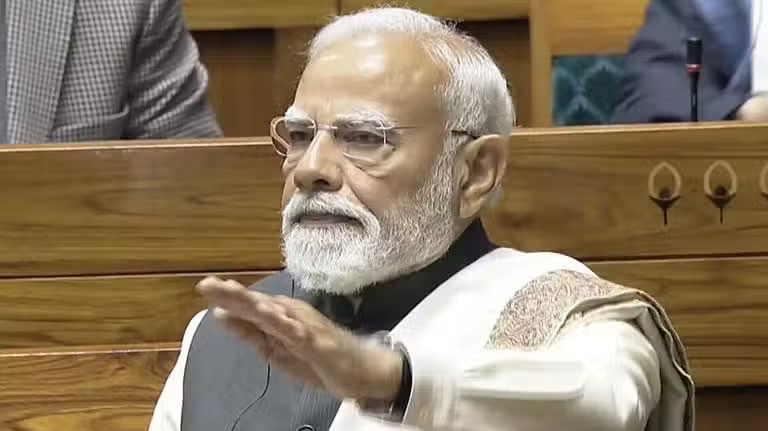


Modi Targets Opposition Over Women’s Bill


Prime Minister Narendra Modi on Saturday reframed the recent setback to the Women’s Reservation Bill as a defining political and ideological confrontation, using a national address to target the Opposition and rally public sentiment—particularly among women voters.
The address came a day after the Constitution (131st Amendment) Bill, 2026—popularly referred to as the Naari Shakti Bill—failed to secure the required two-thirds majority in the Lok Sabha. Rather than treating the outcome as a legislative defeat, Modi positioned it as a “moral battle” between his government’s reform agenda and what he described as an “anti-reform” Opposition.
In a strongly worded speech, the Prime Minister accused Opposition parties, including the Indian National Congress, Dravida Munnetra Kazhagam, All India Trinamool Congress, and Samajwadi Party, of betraying women and undermining their aspirations. “A woman may forget everything, but she never forgets her insult,” Modi said, invoking themes of dignity and self-respect to frame the bill’s rejection.
He described the proposed amendment as a “great mission” to empower women across India, arguing that its defeat amounted to an affront to their rights and ambitions. In one of his sharpest criticisms, Modi alleged that Opposition parties had “snatched women’s rights and then thumped desks in self-congratulation,” calling their stance an attack on women’s dignity.
The Prime Minister further intensified his rhetoric by accusing the Opposition of being driven by “family-based politics” and acting out of fear of losing influence. He also claimed that the Congress and its allies had been “unmasked,” suggesting that their opposition to the bill reflected a deeper resistance to structural reforms.
Strategically, the address signals a shift in the government’s approach—from legislative negotiation to political mobilisation. By projecting the issue as a larger ideological conflict, the ruling dispensation appears intent on consolidating support among women voters, an increasingly decisive demographic in Indian elections.
Modi asserted that “100 percent of the nation’s women power” stands with his government and pledged to remove all obstacles to women’s reservation. His remarks indicate that the issue will remain central to the ruling party’s political narrative in the coming months.
The bill’s failure followed a deeply polarised debate, particularly over its linkage to delimitation and the proposed expansion of the Lok Sabha to 816 seats. Opposition parties had expressed concerns that tying women’s reservation to a future delimitation exercise could delay its implementation and alter political representation across states.
Critics argued that these provisions created uncertainty, while the government maintained that the framework was necessary to ensure equitable representation. The lack of consensus ultimately prevented the bill from achieving the supermajority required for a constitutional amendment.
Notably, Modi’s speech largely sidestepped these procedural complexities, instead focusing on emotive and political messaging. He warned that citizens, especially women, would remember the Opposition’s stance and suggested that electoral consequences would follow.
By linking the current impasse to what he termed a long-standing “anti-reform mindset,” the Prime Minister sought to place the controversy within a broader narrative of stalled progress under previous regimes. This framing positions his government as a driver of change while portraying opponents as obstructionist.
The tone of the address suggests a period of political escalation rather than reconciliation. With limited indications of renewed consensus-building, the government appears prepared to take the issue directly to the electorate, using themes of gender justice, dignity, and representation as key campaign pillars.
Whether this strategy succeeds in broadening support or further deepens political divisions will likely shape not only the future of women’s reservation in India but also the contours of the country’s evolving electoral landscape.